

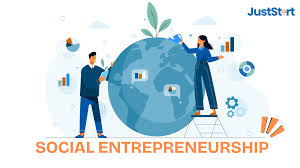
Social Startups : Catalyst of Change Publish Date : 13/04/2026

Social Startups : Catalyst of Change
Professor R. S. Sengar and Others
India's social startups, exemplified by Barefoot College's empowerment of 10 million lives through solar engineers and rural professionals, blend purpose with enterprise for sustainable change. Ventures like OurGuest Travels boost rural tourism in Northeast India, while initiatives in health-tech, agri-innovation, and inclusive skilling address poverty and exclusion. Backed by Startup India, Atal Innovation Mission, and digital infrastructure, they drive Viksit Bharat by enhancing women-led livelihoods and global-scale impact.
In the sandy village of Tilonia, Rajasthan, stands one of India's most powerful demonstrations of what a mission-led, enterprise-driven social startup can achieve when purpose meets sustainability. Barefoot College, founded in 1972, began with a radical yet simple belief that the poorest communities already possess the resilience and capability to transform their own lives, and that what they often lack are platforms, skills and opportunities to participate in economic systems. Over five decades, this belief has evolved into a global development model that has trained thousands of Barefoot Solar Engineers, Barefoot Teachers, Barefoot Doctors, Barefoot Dentists and rural professionals across water, environment, livelihoods, communication and health. Today, withover 10 million lives improved, 5,000 last-mile villages presence and a reach across 96 countries, Barefoot College shows the world that enduring social impact is strongest when communities are empowered through sustainable enterprise and ownership.
The movement pioneered by visionaries such as Bunker Roy has expanded dramatically over the past decade, finding new expression in a new generation of social startups. One such example emerges from Gangtok, Sikkim. OurGuest Travels (www.ourguest. in), conferred the D2C (Direct-to-Consumer) Award at StartupMahakumbh in April 2025, is the first Online Travel Aggregator from Northeast India. It offers a curated collection of homestays, farm stays, resorts and guided experiences across Sikkim, North Bengal, Assam, Meghalaya, Arunachal Pradesh and Jammu & Kashmir. With over 600 homestays, more than 50 trained local guides, and over 6,000 travellers served, the platform demonstrates how tourism-led startups can strengthen rural livelihoods, preserve local culture and promote responsible eco-tourism while remaining commercially viable.
A New Force in Nation-Building
Social startups such as these have carved out a distinctive identity within India's vibrant startuplandscape, contributing to the country's position as the world's third-largest startup ecosystem. These ventures combine the rigour of business with a deep commitment to solving pressing societal challenges including poverty, education, healthcare, climate resilience, clean energy, skilling, accessibility and gender inclusion. Led by founders who recognise opportunity in addressing systemic problems, social startups redefine success by measuring outcomes not only in revenue, but also in tangible, measurable social impact.Today, social startups operate across a wide range of sectors, from ed-tech platforms serving underserved students and health-tech innovations reaching last-mile populations, to financial inclusion models, sustainable agriculture solutions, disability-focused technologies, rural livelihood enterprises, climate-tech innovations and circular economy ventures. Many have demonstrated scale and resilience, proving that profit and purpose are not opposing forces but complementary drivers of growth. Social impact accelerators have supported enterprises like Haqdarshak, which helps citizens access welfare entitlements and has served over 7.6 million families and reached more than 1,12,000 businesses; Frontier Markets, which empowers rural women entrepreneurs through last-mile supply chains, has recorded a Gross Merchandise Value of INR 12 billion; and Trestle Labs, whose assistive technologies for the visually impaired are now used by over 600 institutions, including leading IITs, IIMs, and state and central universities. Across India, thousands of similar ventures are addressing challenges once considered complex, risky and unviable to solve through market-based approaches.Equally significant is the changing profile of the social entrepreneur. Founders now emerge not only from elite Institutions such as the IITs and IIMs, but also from the very communities they seek to serve. Women from rural districts, young innovators from tribal belts, persons with disabilities designing accessibility solutions, and transgender entrepreneurs creating inclusive livelihood models are increasingly shaping India's social startup ecosystem.What was once viewed as a niche sector is steadily becoming a quiet economic revolution, and a sector that invites participation from all sections of society.
The Rise of Inclusive Startup Ecosystem
The rapid growth and inclusivity of India's social startup ecosystem is the result of deliberate policy choices, targeted financial incentives, robust digital public infrastructure and sustained capacity-building efforts by the Government of India. Together, these elements have positioned India as one of the most supportive environments globally for mission-driven entrepreneurship.At the heart of this transformation is the Startup India initiative, launched in 2016, and established a national framework for startup recognition, tax benefits and incubation support. As of 2025, India has 1.9 lakh DPIIT-recognised startups, collectively generating more than 17 lakh jobs and producing 118 unicorns. Within this ecosystem, a growing proportion of startups operate with a social mission, particularly in sector such as healthcare, agriculture, skilling, climate action, education and livelihoods.Another cornerstone is the Atal Innovation Mission (AIM), which promotes social innovation through Atal Incubation Centres, Atal Community Innovation Centres in rural and tribal regions, and the Atal New India Challenges focus on impact-oriented technologies. While initiatives such as, NITI Aayog's Aspirational Districts Programme has also emerged as a powerful testing ground for social startup interventions in health, education, nutrition and livelihoods.Access to finance has been strengthened through multiple government-backed instruments tailored for early-stage, high-impact ventures. These include theFund of Funds for Startups (FFS) managed by SIDBI and the Credit Guarantee Scheme for Startups (CGSS), which facilitates collateral-free lending. Complementary schemes such as PMEGP, Stand-Up India, MUDRA Yojana, the Women Entrepreneurship Platform (WEP), and the Support for Marginalised Individuals for Livelihood and Enterprise (SMILE) have enabled thousands of first-generation entrepreneurs, particularly women, SC/ST youth, persons with disabilities and transgender individuals, to access formal credit, training and mentorship.
Parallelly, digital inclusion has emerged as a powerful catalyst for scale. Through initiatives such as Digital India, India Stack, Unified Payment Interface (UPI) and JAM trinity reforms, millions have been connected to payments, welfare delivery and essential services. This digital backbone has created fertile ground for social startups to expand rapidly, particularly in underserved geographies.
Government-led climate action has further opened new avenues for enterprise-led solutions. Programmes such as the National Solar Mission and Mission LIFE, coupled with initiatives such as United Nations' Green Climate Fund, support initiatives in water, energy and waste management, spurring innovation in renewable energy, climate adaptation, circular economy models and rural green livelihoods.
Building Viksit Bharat Through Social Startups

Perhaps the most transformative contribution of social startups lies in their impact on communities historically excluded from economic opportunity, making them an essential pillar in India's journey towards becoming a developed nation by 2047. Women-led entrepreneurship stands out as a defining force. As women emerge as micro-entrepreneurs, solar engineers, e-commerce sellers, agri-innovators, financial agents, digital facilitators and community health workers, they not only strengthen household incomes but also address deeper challenges such as migration, intergenerational poverty and educational access. Evidence shows that women reinvest up to 90 per cent of their income into their families, compared to 30-40 per cent by men, resulting in improved nutrition, education and health outcomes. Reflecting this shift, the Female Labour Force Participation Rate has risen from 23.3 per cent in 2017-18 to 41.7 per cent in 2023-24, driven largelyby rural women. As of January 2025, over 40 per cent of UDYAM-registered MSMEs are women-owned, supported by startups such as Frontier Markets, Mann Deshi, Barefoot College and Rang De.
Innovation-led empowerment has also transformed opportunities for the differently-abled community. Enterprises such as Trestle Labs, BleeTech, Thinkerbell Labs and ventures like Atypical Advantage focused on employability for all demonstrate how assistive technologies and inclusive skilling can create dignified, independent livelihoods. These efforts align closely with national initiatives including the Accessible India campaign, the Rights of Persons with Disabilities Act, 2016, and Skill India's inclusive skilling programmes.
For transgender entrepreneurs, who have long excluded from mainstream education and employment, social startups have opened new pathways in skilling, beauty and wellness, digital literacy, sustainable crafts, community kitchens, financial inclusion and small enterprises. Supported by schemes such as SMILE and the National Transgender Welfare Board, these ventures combine social transformation with sustainable business models, echoing the Barefoot College philosophy of building competence, confidence and self-reliance from within communities.
From India to the World
In a country defined by diversity, entrepreneurship itself has become more diverse. Increased access to technology, skills, finance and digital knowledge has emboldened individuals to launch ventures across sectors. Healthcare startups deploy telemedicine, Al-based diagnostics, and mobile health units to bridge access gaps. Agricultural startups enable small farmers through precision farming, climate-smart practices and market linkages. Fintech ventures are expanding credit access for unbanked populations using digital identity and alternative data, while ed-tech platforms deliver vernacular, curriculum-aligned learning tools to government school students. Sustainability startups convert waste into value, develop biodegradable alternatives and build decentralised renewable energy systems.The connective thread across these sectors is a shared entrepreneurial mindset where scale, sustainability and social benefit reinforce rather than contradict one another. Increasingly, Indian social startups are designing solutions with global relevance,creating models that can be replicated across developing economies worldwide.India is also witnessing the rise of impact investors, CSR partnerships, philanthropic venture funds and blended finance models. The Social Stock Exchange, launched by SEBI, provides a transparent platform for social enterprises and non-profits to raise capital, signalling India's commitment to building a new financial architecture for high-impact innovation.
Keep Pushing to the Next Level
The emergence of social startups has delivered far more than business-led empowerment. It has reshaped how development itself is understood. Traditional models based solely on charity, relief and welfare proved insufficient to address deeply interconnected socio-economic challenges. In contrast, enterprise-driven models rooted in scale, sustainability and market discipline have demonstrated greater resilience and long-term impact. The participation of private enterprise and market forces has brought capital, accountability and innovation into spaces once dominated by aid.
With ideas from change-makers, policy support from government and capital from markets, entrepreneurship has become a powerful engine of social transformation. The results are already visible: village-level solar grids operated by women engineers, health devices designed by young innovators for ageing populations, climate solutions tailored for drought-prone regions and skilling programmes that enable transgender persons and differently-abled youth to build dignified careers. And this momentum is only a beginning.Yet, social startups must also navigate a defining challenge-time. Solving complex social problems requires patience, persistence and a willingness to engage with layered, interconnected realities. Quick fixes and stop-gap solutions rarely suffice. Continuous learning, collaboration and adaptation are essential. Inclusive growth demands participation from all stakeholders: communities, entrepreneurs, corporates, government, academia and investors. Social entrepreneurship advances the idea that development cannot endure unless people are active contributors, not passive beneficiarles. When communities pay for and participate in services, they become equal stakeholders, ensuring solutions remain participatory, iterative and sustainable.
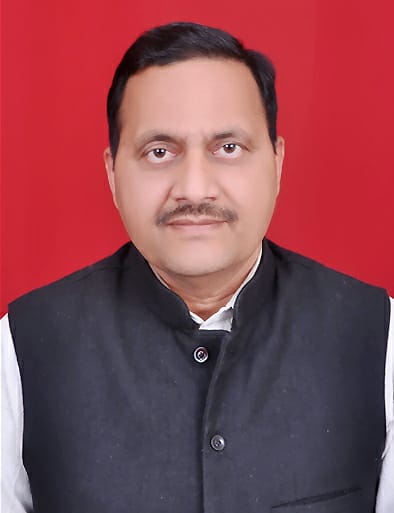
Writer: Professor R. S. Sengar, Director Training and Placement, Sardar Vallabhbhai Patel University of Agriculture and Technology, Modipuram, Meerut.


