

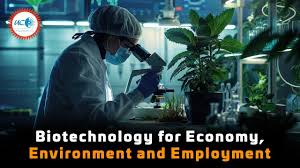
One Year oF One Year of BioE3: From Policy to Action Publish Date : 06/04/2026

One Year oF One Year of BioE3: From Policy to Action
Professor R. S. Sengar
MARKING the first anniversary of the BioE3 (Biotechnology for Economy, Environment Land Employment) Policy of the Department of Biotechnology (DBT), Hon'ble Union Minister of Science and Technology Dr Jitendra Singh launched the BioE3 Challenge for Youth and unveiled India's first National Biofoundry Network on 27 August 2025 at the National Media Centre, New Delhi. He described these twin initiatives as a major step towards positioning biotechnology as a key driver of the country's economy, environment, and employment. "India's bioeconomy has grown from just 10 billion dollars in 2014 to 165.7 billion dollars in 2024, and we are now working towards a target of 300 billion dollars by 2030," the Minister said.
He further highlighted that under the BioE3 Policy, the biotechnology sector has achieved remarkable progress in the past year, with new institutions, partnerships, and research efforts laying the foundation for India's emergence as a global bioeconomy leader. Speaking at the event titled "One Year of BioE3: From Policy to Action", Dr Singh pointed to several major initiatives, including the establishment of India's first Biomanufacturing Institute at Mohali's National Agri-Food Biotechnology Institute (NABI), the creation of bio-artificial intelligence hubs, biomanufacturing clusters and biofoundries across the country, and the launch of over a dozen joint research calls in frontier areas such as cell and gene therapy, climate-smart agriculture, carbon capture, and functional foods. He noted that DBT has already received more than 2,000 proposals in these areas, reflecting the strong response from India's scientific and innovation community. He also drew attention to a memorandum of understanding signed between DBT and the Indian Space Research Organisation (ISRO) for joint work in space biotechnology and biomanufacturing, with a dedicated working group established to identify priority projects.
At the state level, DBT has initiated collaborations to align the BioE3 vision with local needs, such as anMoU with the Government of Assam to set up a BioE3 Cell and implement a state-specific action plan. On the international front, India's missions in 52 countries have shared feedback on the policy, and DBT, together with the Ministry of External Affairs, is advancing follow-up collaborations. These developments underscore the policy's emphasis on both grassroots implementation and global partnerships.
As part of the celebration, Dr Singh also launched the BioE3 Challenge for Youth, a nationwide initiative under the theme "Design Microbes, Molecules & More". Open to school students (Classes 6-12), university students, researchers, faculty, startups, and Indian nationals, the challenge seeks innovative biological solutions that are safe-by-design and address real-world problems in health, agriculture, environment, and industry. Beginning October 2025, the challenge will be announced on the first of every month, with the top 10 entries awarded 1 lakh each, along with recognition and mentoring. A further 100 innovators will be eligible for funding of up to 25 lakh through BIRAC, released in two tranches to support proof-of-concept development. Selected awardees will also gain access toBRIC+ incubation facilities across India, providing both financial and technical backing.
Explaining the framework of the challenge, DBT Secretary Dr Rajesh Gokhale said it is anchored in the DESIGN approach: Define real needs, build Evidence-first solutions, ensure Sustainability by design, pursue Integration with other technologies and policies, develop strategies to Go-to-market, and create a Net-positive impact through measurable outcomes in jobs, inclusion, and equitable access. He stressed that this approach is intended not only to nurture scientific curiosity but also to empower grassroots innovators and advance India's vision of a self-reliant bioeconomy. Another landmark announcement at the event was the launch of the National Biofoundry Network, bringing together six institutions to accelerate proof-of-concept scale-up, strengthen indigenous biomanufacturing, and generate new employment opportunities. Dr Singh noted that this network will help bridge the gap between research and commercialisation, ensuring that new ideas transition into sustainable products and services for national benefit.
Prof. Ajay Kumar Sood, Principal Scientific Adviser to the Government of India, remarked that the BioE3 Policy represents a strategic step towards a green, clean, and prosperous India by leveraging biotechnology to strengthen public health, protect ecosystems, and mitigate climate change. He emphasised that biology today extends far beyond traditional laboratories, converging with engineering. architecture, and space science to drive transformative innovations-ranging from biophilic urban design and algae-hased carbon capture to biodegradable plastics, organ-on-chip systems, and space biology. He added that the fusion of biology with emerging technologies such as Artificial General Intelligence (AGI) is also opening new and exciting career pathways for India's youth.
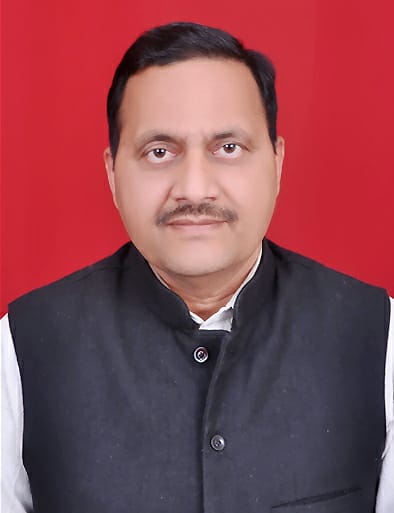
Writer: Professor R. S. Sengar, Director Training and Placement, Sardar Vallabhbhai Patel University of Agriculture and Technology, Modipuram, Meerut.


