

INTERCROPPING DONE RIGHT: MAXIMIZING LAND, WATER AND PROFITS IN ONE SYSTEM Publish Date : 09/11/2026

INTERCROPPING DONE RIGHT: MAXIMIZING LAND, WATER AND PROFITS IN ONE SYSTEM
Professor R. S. Sengar and D. Shalini Gupta
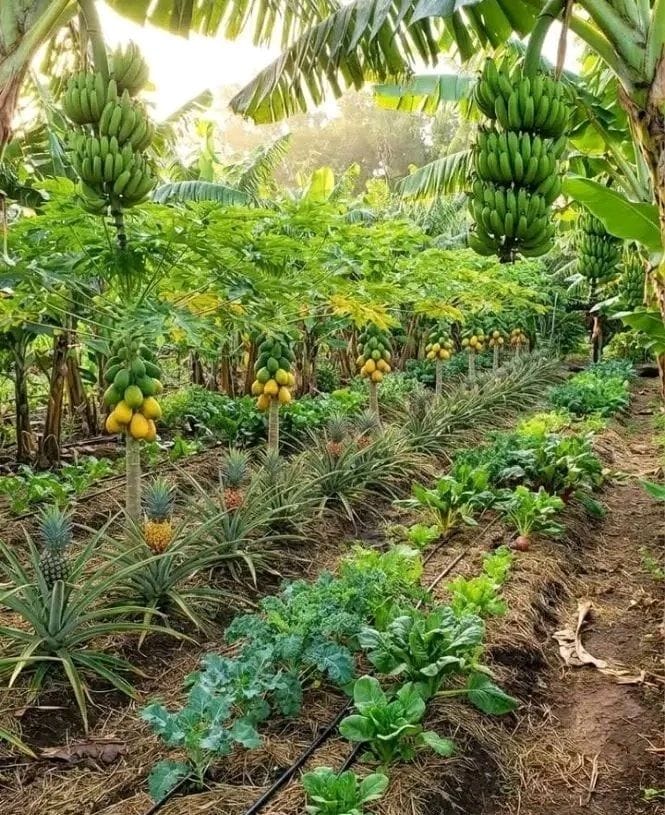
Seeing in this picture is more than a beautiful farm. It is a carefully designed multi-layer cropping system where different crops are grown together to maximize land, water, sunlight and income.
The system combines bananas, papayas, pineapples and leafy vegetables to create a productive and climate-smart farming model.
1. MULTI-LAYER FARMING
Each crop occupies a different layer, helping farmers use available space and resources efficiently:
The Upper Layer: Bananas provide shade and help reduce soil moisture loss.
The Middle Layer: Papayas grow upright and make efficient use of vertical space.
The Lower Layer: Pineapples provide ground cover and help suppress weeds.
The Ground Layer: Leafy vegetables provide short-cycle income while making use of available sunlight.
This arrangement can improve light utilization, moderate soil temperature and help retain soil moisture.
2. BETTER MANAGEMENT of SOIL AND WATER
Good management is essential for making intercropping productive.
Mulching reduces evaporation and protects the soil of the field.
Dense but well-planned planting can reduce erosion and suppress weeds.
Drip irrigation delivers water closer to the crop root zones, reducing unnecessary water loss.
Together, these practices can improve water-use efficiency, especially where rainfall is limited or unpredictable.
3. PEST AND DISEASE MANAGEMENT
Crop diversity can contribute to integrated pest management by making it harder for pests that depend heavily on one crop to spread rapidly across the entire field.
Proper spacing also improves air flow, while good sanitation, monitoring and timely intervention remain important for controlling pests and diseases.
Intercropping should complement, not replace, proper pest and disease management.
4. NUTRIENT USE EFFICIENCY
Different crops have different root systems and nutrient requirements.
Bananas, papayas, pineapples and vegetables use nutrients and water differently, allowing farmers to make better use of the available growing space.
When combined with compost, manure, mulching and proper soil management, the system can improve nutrient cycling and soil health.
5. INCOME DIVERSIFICATION
One of the biggest advantages is the potential for multiple income streams.
Leafy vegetables can provide frequent short-term income.
Pineapples provide medium-term returns.
Papayas can provide repeated harvests over an extended period.
Bananas provide a longer-term source of income.
Instead of depending on one crop, farmers can spread production and reduce the financial risk associated with crop failure or price fluctuations.

Writer: Professor R. S. Sengar, Dean College of Biotechnology and Director Training and Placement, Sardar Vallabhbhai Patel University of Agriculture and Technology, Modipuram, Meerut.


